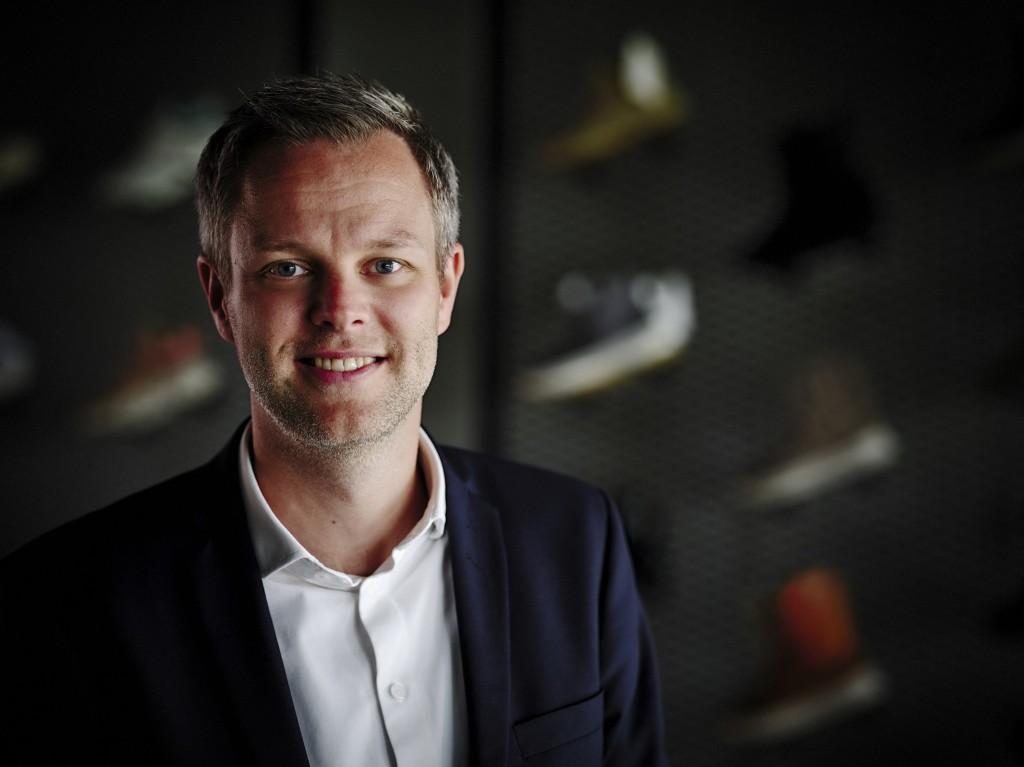
It’s been about 5 months since I started working at Spinnova. I am extremely happy about the big change I made personally, which has already led to so many important learnings, but I’m even more proud of what Spinnova is and what we have achieved.
In the past years, Spinnova has proven that our technology is unique in its value proposition, environmental impact, and application landscape. We have a commercial scale production facility, we have launched real volume products with partners, most notably the innovative Bestseller, and we will continue to do more of these. We have a world-class team of experts in physics, chemistry, process and production technology, and the textile industry. We have skilled and strong partners in both technology delivery and now, as a partner to scale the Spinnova technology after signing our LOI for the next mill with Suzano.
Since December, we have refreshed our strategy to focus on technology sales and delivery. We reorganized the company to reflect our new strategy with a new management team set-up and a new leaner organizational structure to allow us to achieve our strategy targets without the need for external financing.
Our mission is to transform the raw material base of the textile supply chain – a big mission, but that’s the only way to have an impact that is meaningful for our customers and their customers, but also for the planet. A big part of this is reducing carbon emissions and waste as well as having a positive impact on biodiversity. I recently attended a course on biodiversity and realized how much impact human activity can have on biodiversity and how this impacts what our planet gives back to us and our quality of life. We will take this very seriously in all of our work and partner selection.
The fundamentals are on our side. The textile industry needs more fibre, but current sources are either unsustainable or cannot continue to grow. We offer a true alternative to natural fibres and, with the same technology, can do it with renewable and / or recycled feedstocks. Regulation will push for more transparency and reduced environmental impact. We will be ready to help brands, the textile supply chain, and, of course, looking for investments in fibre production technologies.
Two weeks ago, I had the pleasure of attending Challenge the Fabric event, where these trends became even more evident. It was great to see the whole industry, from innovators to established companies, come together to share ideas on how we can make the change happen. Thank you to Ekman for having us and congratulations to our design partners Paulina Russo and Lucile Guilmard for their great work and exciting designs.
Now that we have moved to the execution phase of our strategy, our teams are working hard to cultivate our technology sales customer pipeline, improve the capex efficiency of our technology, and finalize our fibre development to make Spinnova an easy-to-use, value-adding, and scalable fibre in the short-term. Stay tuned to hear more!
The fashion and apparel industry is one of the most polluting industries in the world, accounting for 4% of global emissions and contributing to a multitude of sustainability issues such as water and soil depletion, microplastic pollution, and mounting textile waste. In Europe, consumption of textiles has the fourth highest impact on the environment and climate change, surpassed only by food, housing, and mobility. With the global textile fibre market expected to grow to over 150 million tons by 2030, it’s no wonder that numerous legislative initiatives aim to mitigate the industry’s climate impact.
For example, theUN’s Fashion Industry Charter for Climate Action was launched in 2018 to provide a path for reaching net zero by 2050. The charter aims to reduce the industry’s greenhouse gas emissions by 30% by 2030 through progress in areas such as raw materials, renewable energy use, and circularity.
The EU has also setambitious sustainability targets: their goal is that by 2030 all textile products placed on the EU market are durable, repairable, and recyclable. This is an enormous feat considering the current reality where only 1% of clothes produced globally are recycled into new clothes, hindered by immature infrastructure and low-quality materials unfit for recycling.
Making these ambitious goals a reality will require effort on three fronts: innovations, incentives, and investments.
Luckily for policymakers, legislators, and brands, there’s no shortage of material innovations. On the contrary, in the past five years we’ve seen multiple new innovations in areas such as sustainable materials, resource-efficient dyeing, and textile traceability prove not only their ingenuity, but their commercial viability.
The introduction of material innovations will not be enough to take us far enough on the EU’s roadmap for sustainable textiles, let alone meet the ambitious goals set for 2030. And while many fashion and apparel brands have made commitments to significantly reduce their environmental impact by introducing sustainable materials in their collections – and fashion brands’ demand for sustainable fibres will no doubt continue to grow – inciting widespread change on a rapid enough timeline will require legislators and policymakers to double down on incentives and investments.
Investments and incentives which, as we’ve seen in industries further along in the green transition than fashion, will eventually pay themselves back.
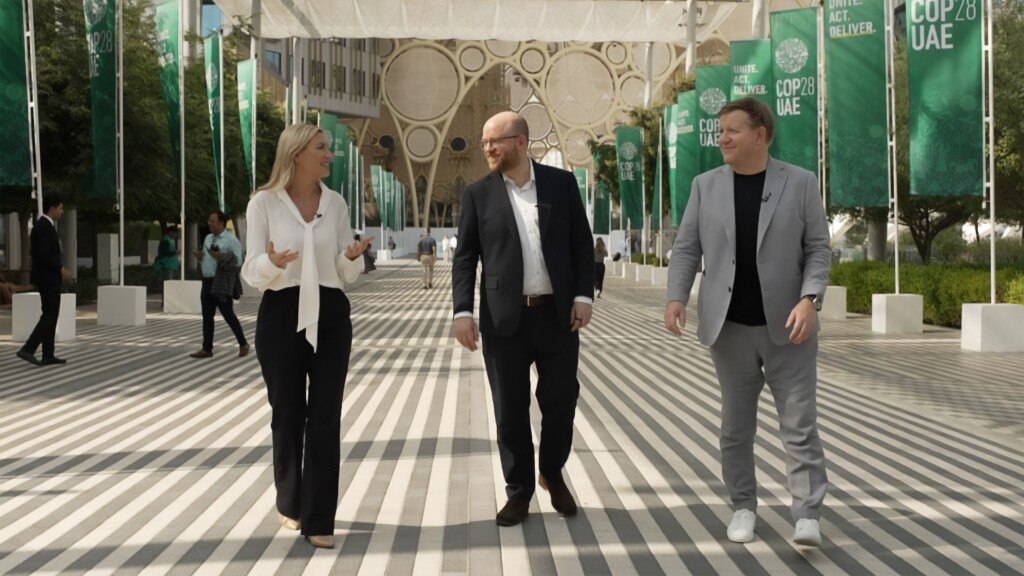
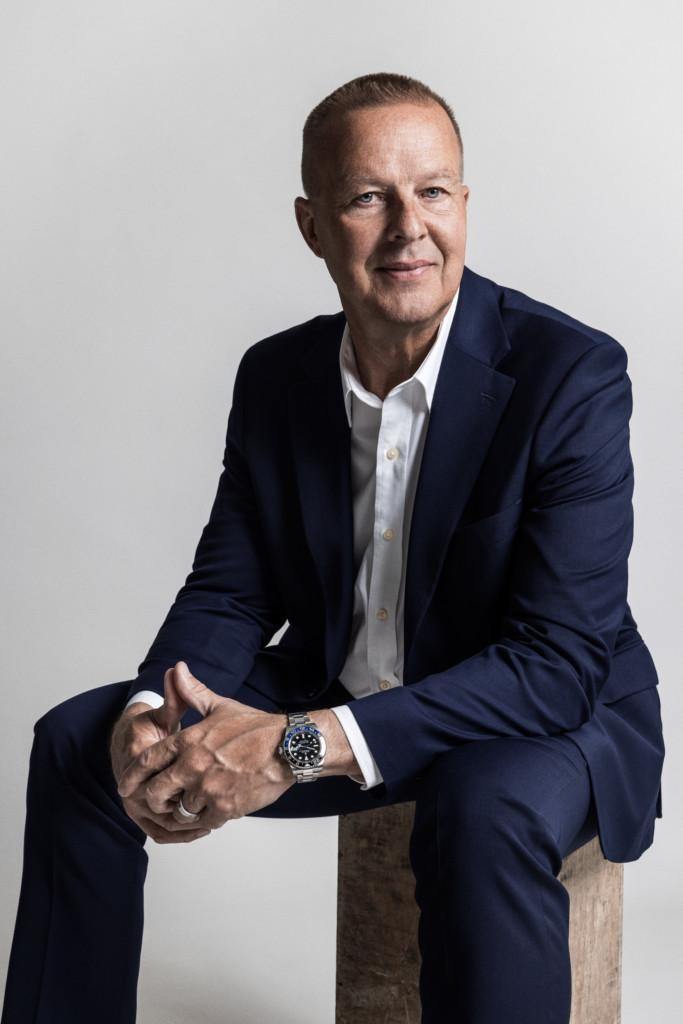
Ben Selby, CFO & Deputy CEO at Spinnova Allan Andersen, Chief Sales Officer at Spinnova
Watch Spinnova’s COP28 Leadership Interview on the topic here.
SPINNOVA HAS ALWAYS BEEN A VALUE-DRIVEN COMPANY, NOW WITH FIVE FRESHLY HONED CORE VALUES. READ OUR CEO KIM’S THOUGHTS ON HOW VALUES HELP US SHAPE SUCCESSFUL BUSINESSES.
We at Spinnova have a bold mission. By producing the most sustainable textile materials in the world we will transform the raw material base of the entire global textile industry for better.
One of the key differentiators of Spinnova, to me, was the unique company DNA that is reflected in our mission and the strong values driving the company forward every day. I’m a true believer in leading through deeply rooted, shared values – not least because having clear company values is one of the key drivers of innovation and growth.
Spinnova, a forerunner of the green textile revolution, is not only founded on but continues to grow respecting its values. But in order to be actionable, these values must be interpreted and understood in the same way by everyone, while reflecting the reality of everyone’s various work tasks. To be able to live up to our values, they need to be crystal clear to everyone. At Spinnova, here’s how we explain and adhere to our five core values:
Trust to be trusted
We are on a world-changing mission to transform the raw material base of the global textile industry – and we truly believe and trust that it is possible. Trust starts with being transparent, open, and optimistic both as individuals and as a company.
Succeed and fail as a team
We are lucky to work with talented and value-driven people, united by the will to change an entire industry. We share common goals and acknowledge that reaching it requires seamless teamwork. We celebrate success and learn from failures as one team. We cooperate across teams – within our company, and with our partners.
Passion for innovation
We create tomorrow’s solutions today. We test, we learn and we evolve – both personally and professionally. We believe that by finding small improvements every single day, they will eventually accumulate into groundbreaking innovations. Similarly, when facing little failures here and there, we own them, we learn from them.
Love our planet
Our planet has its limits, and the only option we have as humankind is to become truly sustainable. Nature is the source of inspiration for our technology and the reason for Spinnova’s being. We care deeply about our environment and have chosen to never compromise that.
Courage to change the world
Finally, pioneering requires courage. We will definitely face obstacles and suspicions along our way and leaping beyond them calls for many things, most of all, courage and optimism. We are brave in the face of the unknown and never hesitate to try something new and disruptive for the first time. We welcome the change with an open mind and we are not afraid to change direction.
These five values guide us when making our daily decisions, big or small. I feel confident and trust that by living up to these values we can reach our goals on our mission to transform the raw material base of the entire global textile industry.
Kim Poulsen, CEO at Spinnova
ZERO EMISSIONS DAY IS AN EVENT ORGANIZED ANNUALLY ON SEPTEMBER 21ST. BELOW YOU CAN FIND A SHORT REFLECTION ON THE TOPIC BY SPINNOVA’S SUSTAINABILITY COORDINATOR LAURA LEINONEN.
Zero Emissions Day is an event organized annually on September 21st. Originating from Canada (2008), the event’s goal is to increase awareness on the harmful consequences of greenhouse gas emissions and to promote solutions that can help mitigate those emissions. Spinnova’s technology enables the mitigation of greenhouse gas emissions in the textile and fashion industry, and this article is a short reflection on the topic by Spinnova’s Sustainability Coordinator Laura Leinonen.
Greenhouse gas emissions in the textile and fashion industry account for 4% of all global greenhouse gas emissions1. Spinnova has developed a technology that enables the mitigation of these greenhouse gas emissions, but how does this happen and what kind of other complementary measures can help the society shift on a safe low-carbon path?
Low-carbon materials
Spinnova’s biggest impact on climate change mitigation comes from its technology that enables access to low-carbon (or even CO2 negative) materials that can be taken into use by brands or other businesses. The carbon footprint of Spinnova fibre is very low, and for example replacing cotton with SPINNOVA® reduces the emissions that enter the atmosphere. If we consider the surplus energy at Woodspin’s first factory and its consequent utilization, this saving becomes even bigger. There is a calculation formula below to demonstrate the emissions reduction potential of Spinnova fibre:
Emissions of cotton: P
Emissions of SPINNOV®: S – e , where
e = emissions reduction due to energy surplus
S = SPINNOVA®’s carbon footprint
Emissions reduction potential: P – (S – e) = P – S + e, which is > 0
This means that Spinnova has a great potential to mitigate and even reduce the greenhouse gas emissions in the textile and fashion industry. The reduction or saving is the bigger, the bigger the difference in the carbon footprint compared to the other fibre, and the more the surplus energy can be used to replace energy otherwise produced with fossil fuels.
Demand side mitigation
As IPCC’s recent Working Group III report: ‘Climate Change: Mitigation of Climate Change’ demonstrates, limiting the climate change to 1.5 C degrees requires, in addition to low-carbon solutions, demand side actions. The demand side mitigation can be divided in three parts: (1) changes in infrastructure use (2) end-use technology adoption, and (3) socio-cultural and behavioral change. In addition to developing sustainable solutions, Spinnova has an impact on the demand side mitigation both as an end-use technology adopter and as a driver for socio-cultural and behavioral change.
End-use technology adoption
End-use technology adoption refers to, for example, the adoption of low-carbon and energy-efficient energy solutions (e.g. solar panels, ground heat, heat pumps) and other low-carbon technologies that are directly used by the user. Spinnova has had a strong role in adopting novel low-carbon technologies, such as the above-mentioned smart energy system of Woodspin, which we already learned to be an essential element in enhancing the emissions reduction potential of Spinnova fibre.
Socio-cultural and behavioral change
Socio-cultural and behavioral change includes not only individual behavioral change (e.g. reducing long haul aviation, increasing the use of public transportation and shifting towards plant-based diets) but also structural and cultural changes in a broader manner. Systemic change requires not only individual behavioral change but also collective action where the changes in the environment support the shift to low-carbon lifestyles.
Let’s take textile and fashion industry as an example. Climate change mitigation in the textile and fashion industry requires the previously mentioned new technologies and other solutions, such as low-carbon materials, to be taken into use. On the same note it must be mentioned that if the consumption keeps on rising in the same pace, the emissions reduction achieved through the new technologies may be overturned. Socio-cultural change in which orientations such as ’sufficiency’ – where the central idea is to reduce consumption – and ’sharing economy’ – where consumers use products instead of owning them – become prominent, could be one effective way to reduce the use of natural resources to a sustainable level. In the context of textile and fashion industry this socio-cultural change could be reflected by abandoning fast fashion, limiting the number of new collections, conducting responsible marketing and sales practices, designing long-lasting and easily repairable products, and by making repair, resell and renting services more common and widely used.
As we see, a large-scale change towards a zero emissions society is only possible with the collaboration of different actors in the society. Everyone can, however, decide themselves in which capacities they wish to take part in that change – be it in the role of a consumer, citizen, professional, role model, activist, investor, or policymaker.
Laura Leinonen, Sustainability Coordinator at Spinnova
1McKinsey & Company: Fashion on Climate Report, August 26 2020
Green textile revolution, a great step for humankind.
To begin with, I couldn’t be more thrilled to start my first day as the CEO of Spinnova. After starting its operations in 2014, Spinnova has shown impressive progress at the forefront of the green textile revolution. Spinnova’s ambitious mission is to transform the raw material base of the entire textile industry for the better.
So what is Spinnova? At the core of Spinnova is the most sustainable fibre production technology that is built differently from scratch. Spinnova’s technology is revolutionarily disruptive and the plant being built now for Woodspin will even be climate positive. The company is on a mission to transform the traditional textile industry with its revolutionary technology – all while building a global ESG trailblazer.
Why do I believe Spinnova can transform a traditional industry? Spinnova’s world-class innovative team combined with new disruptive technology allows us to shape what the future reality of textile can and will look like. We are a truly unique company with the potential to scale across many industries around the globe via multiple business model options. We already have strategic partnerships with global powerhouses like Suzano, the world’s largest pulp producer. The partnerships with Adidas, The North Face, H&M Group, Bestseller and Marimekko stand as strong examples of what we can achieve with customers.
How are we going to reach our target? It all starts with the relentless and uncompromising dedication to sustainability and planet Earth. Every day, our dedicated team of world-class professionals and team players work towards the common goal. Lastly, our current and future, partners across the value chain will walk the talk and inspire the way for a better environmental future.
On a personal note, I am incredibly humbled and honored by this once in a lifetime opportunity. At Spinnova, we all play for the common goal. This combined with Spinnova’s unique DNA which I would summarize with three words: genuine, honest and dedicated. Keeping this in mind, I am ready to lead Spinnova on the journey to a more sustainable future. The unshakable dedication to the protection of our environment and planet Earth will continue serving as the driving force behind all our operations.
Together with ECCO we are going beyond upcycling leather waste, and creating a brand new leather-based textile material using our sustainable process. The end result is a suede-like material that possesses the natural durability of leather and the light weight and feel of a traditional textile, and we know consumers are looking forward to it as well.
Last year, we surveyed 1,570 people in Finland, Sweden, Germany, France and the US, about their views on textile materials. It probably comes as no surprise that nearly 80% of the respondents worldwide said that textile materials affect their buying decision either significantly or somewhat. In the same survey, we asked the respondents how they feel about different textile raw materials, such as leather waste. The results underline what we’ve suspected – consumers are eager to finally close leather’s circularity loop.
The main finding was that 80% of respondents saw leather waste as a sustainable option. This is not surprising because the use of recycled materials was also seen as a strong sustainability indicator. When we asked if the respondents would want to use clothing or footwear made out of leather waste, about 70% of the global respondents said yes. In France and Germany, the number was nearing 75% and on a global scale, nearly 80% of men wanted to use clothing made out of leather waste.
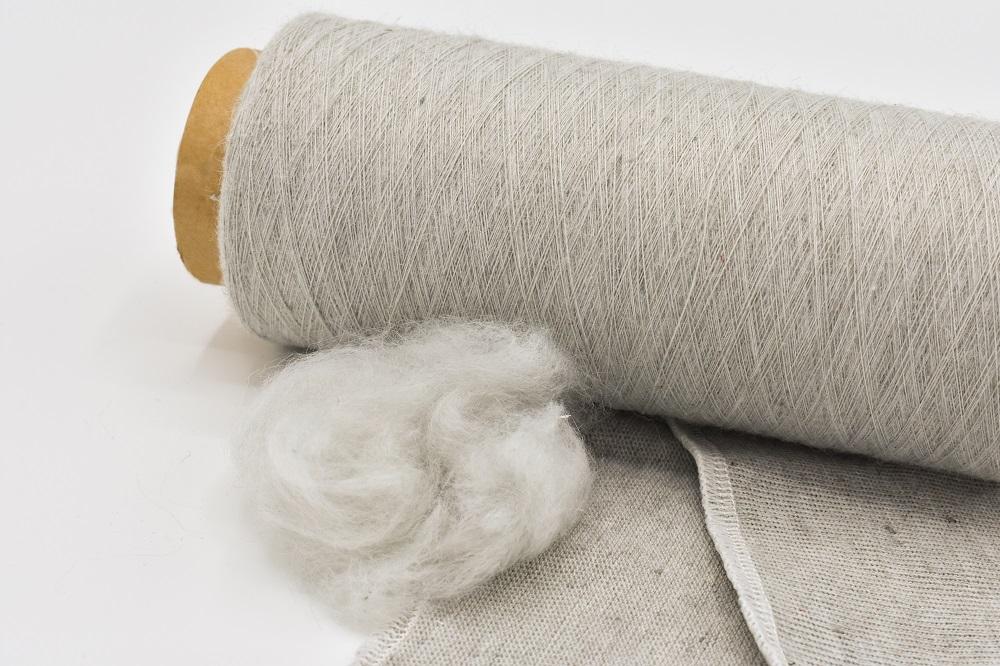
Leather waste made fibre, yarn and knit fabric.
These results send a strong message that consumers see leather waste as a promising new material. And we agree, which is why we are in a R&D collaboration with ECCO’s Applied Research Division, to spin leather waste into SPINNOVA® fibre, and finished building a production pilot for it in Finland last December.
Even though the fibre is made out of real leather, its properties allow us to use it like other textile materials. It’s malleable, stretchy and durable, and it can be used in a number of different applications. We are just beginning to explore the possibilities!
But why leather waste, you may ask. Well, for a number of reasons. The most simple one is because processing leather waste doesn’t require any further technology development from Spinnova—but it’s a huge advancement in circularity for the leather industry. Just like we can spin wood pulp into fibre, we can also spin the protein biomass using the same mechanical process and no harmful chemicals. We are, after all, a technology platform that is able to turn a number of raw materials into textile fibre.
Follow our channels for the latest developments in this project and stay sustained!
Tiina Alahuhta-Kasko, CEO, Marimekko: Timeless design brings joy from one generation to another
Could you describe Marimekko’s sustainability strategy?
Marimekko’s design philosophy and operations have from the very beginning been based on sustainable thinking, and we want to be a pioneer in developing more and more sustainable products and policies, and by our own example lead the entire industry towards a more sustainable future. Corporate responsibility is today a must for a company to be sustainable, but us at Marimekko also see it as something that opens new, value-adding doors to our business, as we serve our growing global target audience. We believe that timeless, sustainable products of the future are made in harmony with the environment, according to circular economy principles and with complete transparency, starting with raw materials.
Our long-term vision is for our operations not to leave a footprint on the environment. Achieving this requires innovation in technology, materials, and business models, and we are committed to continuously advance them together with our partners. Our sustainability strategy, that entails both our own operations and our entire value chain, guides us on our path towards our long-term vision that is built around three main principles: “Timeless design brings joy from one generation to another”, “Products of the future have no footprint”, and “Towards positive change with justice and equality”.
Tiina Alahuhta-Kasko
How do you see Spinnova as part of Marimekko’s strategy?
We are very happy about our collaboration with Spinnova since 2017 on developing and commercializing new, wood-based textiles. Increasing the proportion of more sustainable materials in Marimekko products is one of the main goals of our sustainability strategy. The SPINNOVA® fibre is an extremely promising new material that enables minimizing the environmental footprint of the entire product lifecycle made of it, without compromising comfort of use.
How do you see our near future together?
We are excited to work towards bringing the first products made with the SPINNOVA® fibre into commercial lines. Achieving our ambitious long-term sustainability goals requires close collaboration with different partners and network, and new innovations in the industry. Spinnova has been an important partner on our sustainability journey for years.
This is an abbreviated transcript of the discussion between ECCO’s Chief Operating Officer Thomas Goegsig and Spinnova’s CEO Janne Poranen at the Financial Statements Bulletin Webcast on 24 February, 2022.
If you want to watch a recording of the webcast, this discussion starts from about 22 minutes into the recording.
Thomas Goegsig, can you outline ECCO’s strategy?
We’ve been in the game of footwear for around sixty years. Our entire business relies heavily on our values: care, excellence, heritage and innovation, everything fuelled by passion. This is very important to us and defines everything we do in sustainability.
If we’re talking about the environmental side of sustainability, we rely heavily on code of conduct in general, and this is something that was formulated more than 25 years ago. In this code of conduct, our ninth commitment states that ECCO aims to be a leader within environmental and health and safety aspects, and that we support sustainable developments, and this (the Respin collaboration) is a prime example.
If we then look into our business model, it really starts to materialize. ECCO owns and operates the entire value chain. This is unique in the footwear industry, so when everybody outsourced their production and responsibility in this regard in the nineties, early 2000, we invested heavily in our own systems.
Thomas Goegsig
Can you describe your sustainability efforts?
Our strategy definitely sits with us shouldering responsibility of not only producing our own products, we also produce and prime our own materials like leather, we own tanneries, we own shoe factories, and we bring it all the way to our end consumer through our own channels. We also have wholesale accounts and that whole network, but we bring everything from raw hides all the way up to the consumers. This is something we have nurtured and developed and finetuned over the sixty years of our lifespan so far, and this is something we will rely on going forward.
Lately,. we formulated some more tangible goals related to environmental sustainability, announced in our annual report in 2020, emphasizing that we put some ambitious targets to our operations. In 2024, we aim, and are well underway, to make our headquarters energy neutral. In 2026, we aim at a 90% recovery of all our waste streams in all our facilities and in 2028, we’re aiming for total energy neutrality through all our facilities and that means tanneries and shoe factories but also shops and everything we control. In 2030, we aim at a net zero water discharge. So when we are engaging with Spinnova and Respin, this is for a reason, and we are very excited about this journey, with great expectations.
How do you see our plans together going forward?
What we’re doing in futuristic, and that’s why we’re here; back to our core value of innovation, and also believing we are excellent in what we’re doing, and I think we share this with you. It’s real and we work actively already with the fibres, with the textiles.
For us, it’s quite interesting because we are inventing a completely new material, merging the best from leather and textile and eventually create a leather textile. This is also a challenge, because how do you categorize and define this material, but for us this is about closing the loop and extending the lifetime of our core and prime material, leather. We take some of the waste in our tanneries and turn it into completely new material. This tells us we have a strategy for end of life for leather products, even though they are highly durable. This technology is very interesting and also holds a lot of promise. This is based on some of the first trials and products we have managed to turn into shoes.
It’s also something we want to expand and finetune over this year. We have quite robust plans on how to bring the first products through our chains during this year. We now have a pilot plant running in Finland and it’s what we all hoped and planned for, and it’s so nice to see this is materializing. That tells us this is something we will succeed with.
ECCO never just works on nice ideas, we want to bring them to life.
To read more on ECCO’s responsibility pop to their Group website!
Microplastic have been part of the public discussions since the mid-2010’s, but we still don’t know the full extent of the problem they pose. Being 100% microplastics free is one of the sustainability promises of Spinnova’s materials.
Microplastics are minuscule plastic particles, invisible to the eye, that originate from materials and waste made of plastic. A significant part of this problem is polluting microfibres from synthetic textile materials – in fact, clothes made from these were estimated to contribute 35% of the primary microplastics released into our oceans and waterways in 2017. In addition, TextileExchange estimates that the annual amount of primary synthetic microfibers released from textiles is around an eye-watering 500 000 mt per year.
Microplastics accumulate in the environment, fish and us humans
Considering the vast amounts of microfibres released into our environment annually, it is alarming to learn that we don’t even know the full extent of the impact they have as they are hard to detect and track. What we do know – based on many scientific studies – is that microplastics accumulate in the environment, fish, animals and us humans.
Across oceans and other bodies of water, fish and other sea creatures mistake microplastics for food, and carry them up the food chain to other animals and humans who eat these fish. However, microplastics do much more than merely accumulate in animals and humans as the chemicals used in plastics can cause cancer, damage to the kidney, liver and intestines, and abnormalities in hormonal balance. These microfibres occur not only in water, but can be also found in air which can cause lung damage in material factories, for example, where they can pose a health risk to the workers.
Spinnova one of the solutions
We don’t have time to find out what the long-term effects are at scale – we need to change the way we use materials in the textile industry fast, by embracing sustainable and natural materials. The very reason why we ensured our SPINNOVA® materials – just like all pulp-based materials – sheds no microplastics nor polluting microfibres to the environment.
The best part is, we’re not solving this problem alone. Alongside us, other finalists in the ongoing Conservation X Labs (CXL) Microfibre Innovation Challenge are also working on innovations to reduce microplastics in the environment. For example TreeKind is creating a plant-based leather alternative from waste, and Pangaia is applying MTIX’s multiplexed laser surface enhancement technology to modify the surfaces of fibers within a fabric to prevent microfiber shedding. And these are few of the many innovations accelerating the efforts to make a more sustainable tomorrow.
Sources
International Union for Conservation of Nature (IUCN), Primary microplastics in the oceans (2017)
TextileExchange, Preferred Fibre & Material Market Report (2019)
Sunanda Mishra, Chandi charan Rath, Alok Prasad Das, Marine Pollution Bulletin, Marine microfiber pollution: A review on present status and future challenges (2019)